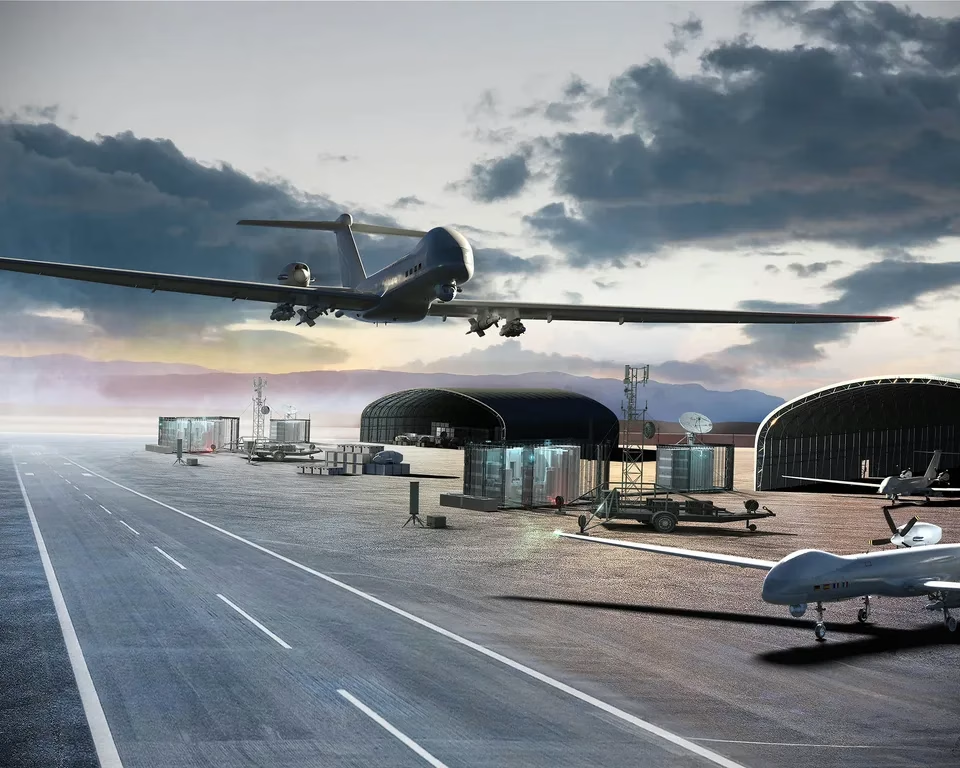
A model of the Eurodrone, a major pan-European defence project, is on static display, offering visitors a close look at what is poised to become Europe's flagship unmanned aerial system.
Developed jointly by Germany, France, Italy, and Spain, the Eurodrone is designed to give Europe its own long-endurance, multi-role remotely piloted aircraft system (RPAS) with full integration capability in civilian airspace.
The programme is managed by OCCAR (Organisation for Joint Armament Cooperation), with Germany as the lead nation. Airbus Defence and Space serves as the industrial prime, working in partnership with Leonardo of Italy, Dassault Aviation of France, and Airbus Spain.
The Eurodrone is notable for being the first RPAS specifically built for operation in non-segregated airspace. It is being developed to meet NATO STANAG 4671 Ed. 3 requirements, along with applicable civil aviation standards, allowing the system to fly safely alongside commercial aircraft and avoid being restricted to military-only flight corridors.
Capable of carrying a mission payload of 2.3 tonnes and flying for up to 40 hours, the Eurodrone is positioned to support a wide array of missions — from armed ISTAR (intelligence, surveillance, target acquisition and reconnaissance) to naval tasks including anti-submarine warfare, and eventually to roles in airborne command, control, and early warning.
In a development that signals broader international interest, India has joined the programme as an observer. According to Airbus, India's participation reflects growing strategic alignment with European partners in the defence domain. OCCAR officials see this step as an exploratory move that could evolve into deeper cooperation.
Still in development, the Eurodrone is expected to enter service later this decade and is seen as a key step toward enhancing European defence autonomy, reducing dependence on non-European systems for critical ISR and strike missions.