What does it take to protect the airspace when threats are becoming more numerous, more diverse and harder to counter? The proliferation of unmanned aerial systems, cruise missiles, precision-guided munitions and increasingly sophisticated electronic warfare capabilities has transformed the way nations approach airspace protection. While advanced sensors and interceptor systems remain essential, the effectiveness of any integrated air defense architecture ultimately depends on one critical capability: command and control.
Modern air defense is no longer defined by individual platforms but by the ability to integrate sensors, decision-makers and weapon systems into a unified operational framework. Generating a common operational picture, assessing threats in real time and coordinating engagements across multiple layers have become indispensable requirements for protecting national airspace.
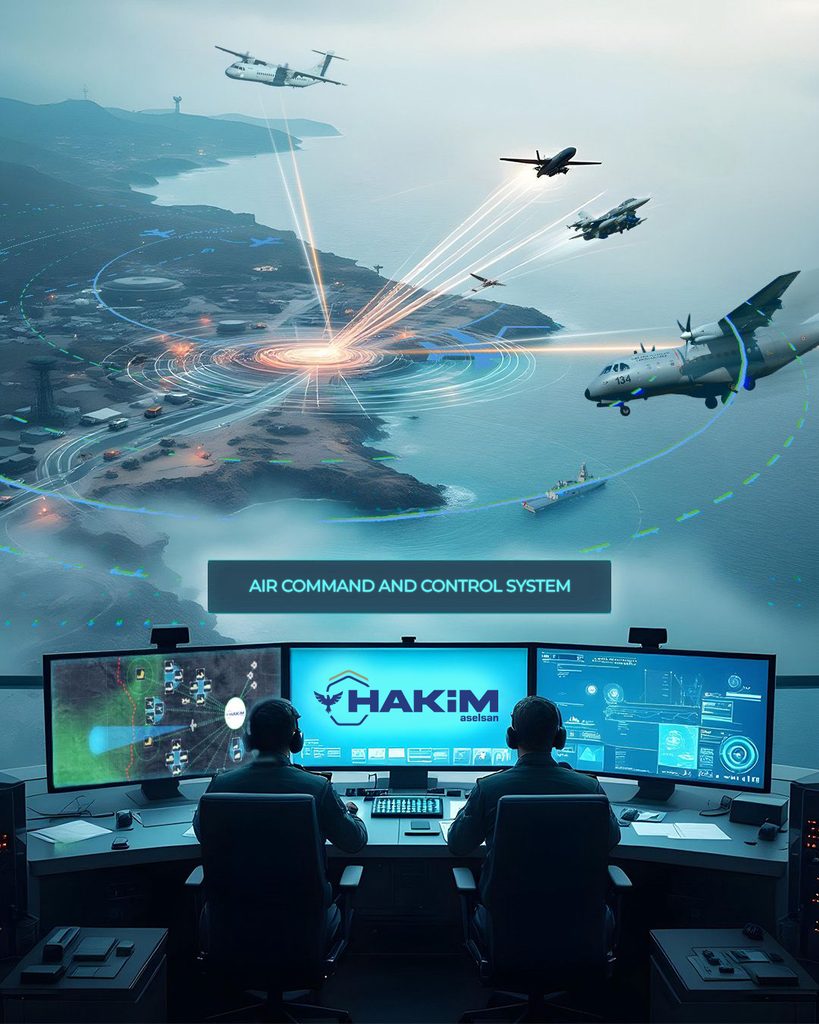
Developed by ASELSAN, HAKİM has been engineered to serve as the command-and-control backbone of integrated air defense operations. Designed as a scalable and network-centric Air Command and Control (Air C2) system, HAKİM connects surveillance assets, weapon systems and command centers into a single operational environment, enabling faster, more informed decision-making.
At the heart of HAKİM is its advanced multi-sensor data fusion capability. Information collected from different type of radars, electro-optical systems, Identification Friend or Foe (IFF) assets and other surveillance sources is correlated and fused to generate a continuously updated Recognized Air Picture (RAP). By eliminating duplicate tracks and presenting operators with a comprehensive view of the airspace, the system enhances situational awareness while reducing operator workload during high-tempo operations.
As air threats become increasingly diverse and simultaneous, decision superiority has become as important as detection performance. HAKİM incorporates sophisticated Threat Evaluation and Weapon Assignment (TEWA) algorithms that automatically analyze incoming threats, prioritize engagements and recommend the most appropriate response based on operational parameters, weapon availability and engagement geometry. This decision-support capability enables commanders to react more effectively in time-critical scenarios while maintaining control over increasingly complex air defense operations.
Designed around an open and modular architecture, HAKİM integrates seamlessly with a wide range of air defense assets, including surveillance radars, surface-to-air missile systems, fighter aircraft and higher-echelon command centers. The system's scalable design allows it to support national air defense networks of varying sizes while facilitating future capability enhancements and the integration of emerging technologies.
The growing emphasis on network-centric warfare has further increased the importance of resilient command-and-control infrastructures. For countries seeking to establish layered and interoperable air defense architectures, the ability to synchronize sensors and effectors across geographically dispersed operational environments has become a defining operational requirement. HAKİM has been developed to address precisely this challenge, enabling coordinated air defense operations through secure, real-time information sharing and centralized command functions.
The system has already demonstrated its operational value beyond Türkiye. One of its most significant international implementations has been in Azerbaijan, where HAKİM serves as a cornerstone of the country's modernized air command and control infrastructure. This deployment highlights the system's adaptability to different operational requirements while reinforcing the growing importance of indigenous, interoperable command-and-control solutions in regional security architectures.
As security dynamics across different regions of the world continue to evolve, investment in integrated command-and-control capabilities is becoming increasingly critical. Advanced surveillance sensors and interceptor systems can only achieve their full operational potential when connected through an intelligent command network capable of transforming information into actionable decisions.
By combining advanced data fusion, automated decision support, network-centric architecture and scalable integration capabilities, HAKİM reflects ASELSAN's vision for the next generation of integrated air defense command and control, providing the digital backbone required for effective, coordinated and resilient airspace management in today's complex operational environment.