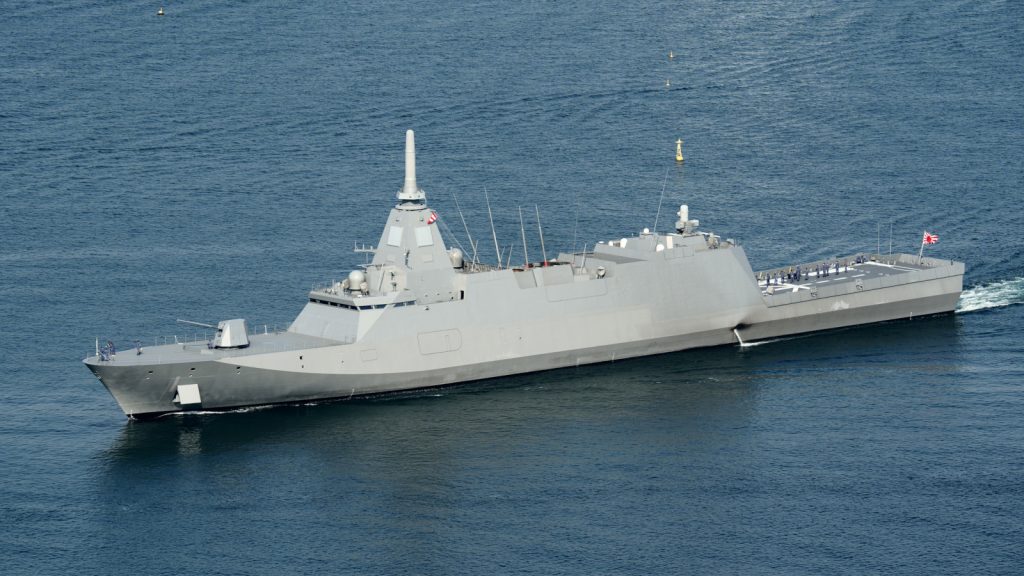
Indonesia has renewed its interest in acquiring eight Japanese Upgraded Mogami-class frigates, or New FFMs, reviving a naval procurement plan that first emerged in 2021 but subsequently lost momentum.
The renewed interest was reported following the first trilateral defence talks between Japan, Indonesia and Australia on 26 August 2026. Unlike the original proposal, which centred on Japan’s baseline Mogami-class, the latest concept involves the larger New FFM design, which offers increased weapons capacity and greater growth margin.
The original 2021 proposal called for Japan to supply four frigates from its own shipyards, with another four to be built by PT PAL in Surabaya. The package was valued at approximately ¥300 billion. Financing was reportedly one of the factors that hindered progress, as Indonesian procurement rules required an upfront payment of 10–20 per cent, equivalent to roughly ¥30–60 billion for a ¥300 billion programme.
Japanese engagement with Indonesia continued despite the lack of a contract. Japanese Mogami-class frigates visited Indonesia in 2023 and 2025, while Indonesian Defence Minister Sjafrie Sjamsoeddin and TNI AL Chief of Staff Adm. Muhammad Ali visited the Japanese Maritime Self-Defense Force's JS Kumano during a 2025 visit to Yokosuka. Adm. Ali subsequently confirmed in April 2026 that Japan had renewed its offer of the frigate.
The New FFM represents a substantial increase in size and capability over the original Mogami. The baseline design is 133 m long and displaces about 5,500 tonnes at full load, while the New FFM is approximately 142 m long and has a full-load displacement of about 6,200 tonnes.
The larger hull provides additional capacity for weapons, electrical systems, sensors and future upgrades. Most significantly, the New FFM carries 32 Mk 41 strike-length vertical launch system cells, compared with 16 cells on the baseline Mogami.
The Mk 41 system can accommodate different weapon configurations. Japanese New FFMs are intended to employ Type 23 surface-to-air missiles and Type 07 vertical-launch anti-submarine rockets, while Australia's version is planned to use RIM-162 Evolved SeaSparrow Missiles. The latter demonstrates the ability to tailor the launcher and weapon fit to the requirements of an export customer.
The frigate also retains a 127 mm Mk 45 naval gun, SeaRAM close-in weapon system, 324 mm lightweight torpedoes and facilities for operating a helicopter. Japan additionally plans to integrate an improved Type 12 anti-ship missile. The baseline Mogami carries eight Type 17 SSM-2 anti-ship missiles in two quadruple launchers.
The New FFM is also significant because it forms the basis of Australia's SEA 3000 General Purpose Frigate programme, which calls for 11 ships. Japan itself is transitioning from the original Mogami programme towards the New FFM, with plans to acquire approximately 12 of the enlarged frigates between fiscal years 2024 and 2028.
For Indonesia, the Australian programme provides an established export and production precedent for the New FFM, while local industrial participation remains an important consideration. Indonesian Ambassador Heri Akhmadi has advocated technology transfer and greater access to Japanese shipbuilding techniques and naval systems rather than limiting the arrangement to the import of completed vessels.
However, Indonesia has yet to enter contract negotiations for the eight frigates. Jakarta is expected to resolve its parallel discussions with Japan over the acquisition of second-hand Asagiri-class destroyers before moving further with the New FFM proposal.
Working-level discussions over the Asagiri-class began in June 2026, following the signing of a Japan-Indonesia Defence Cooperation Arrangement on 4 May covering defence equipment, technology and maritime cooperation.
The reported revival therefore represents renewed Indonesian interest rather than a confirmed acquisition. The ¥300 billion figure remains associated with the original eight-ship Mogami proposal from 2021 and should not be regarded as the price of a prospective eight-ship New FFM programme.