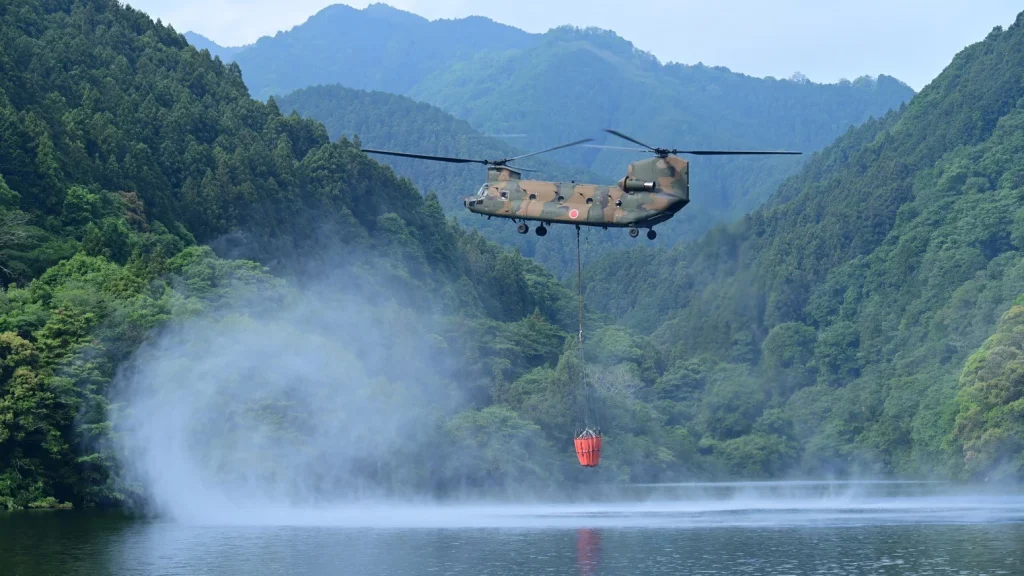
Japan will deploy three Ground Self-Defense Force (JGSDF) CH-47 Chinook helicopters to Indonesia aboard the Japan Maritime Self-Defense Force (JMSDF) transport ship JS Kunisaki to support firefighting operations in Kalimantan, responding to a request from the Indonesian government.
The deployment, announced by Japanese Defence Minister Shinjiro Koizumi on 28 August, will be carried out as an international disaster relief operation. The Japanese Ministry of Defense said the Kunisaki will depart for Indonesia once preparations are complete, carrying the three helicopters and approximately 600 JSDF personnel involved in the mission. Japanese media reported that this will be the first time the JSDF has deployed overseas specifically to conduct firefighting operations.
The Japanese deployment comes as Indonesia faces a major escalation in forest and peatland fires across Kalimantan. Indonesian authorities have concentrated firefighting resources in West, Central and South Kalimantan, where prolonged dry conditions and an intensifying El Niño have made fires particularly difficult to contain. Peat fires are especially challenging because combustion can continue beneath the surface after visible flames have been extinguished.
The scale of the Indonesian response illustrates the severity of the situation. The Indonesian government said 52 aircraft had been deployed for fire response operations across six high-risk provinces as of 20–21 August, including 30 aircraft operating in Kalimantan. The aircraft have been used for aerial surveillance, weather modification and water bombing.
West Kalimantan has been among the worst-affected areas. The burned area there had already reached 28,680 hectares by June, exceeding the 26,703 hectares recorded during the whole of 2025. By August, the fires had continued to expand, producing dense haze that crossed into Malaysian Borneo. Nationally, Indonesia's Forestry Ministry reported that almost 94,000 hectares had burned in July alone.
Japan's CH-47s will add a substantial heavy-lift helicopter capability to Indonesia's existing firefighting fleet. The aircraft can operate as aerial firefighting platforms when fitted with suitable water tanks or buckets, while their transport capability also allows them to move personnel and equipment into areas that are difficult to reach by road. The precise firefighting configuration and operating locations of the Japanese helicopters have not yet been announced.
The deployment also has a clear bilateral defence-cooperation context. Indonesia and Japan signed a Defence Cooperation Arrangement (DCA) in Jakarta on 4 May, expanding their existing defence relationship into areas including humanitarian assistance and disaster relief, alongside military exchanges, training, maritime security and defence equipment and technology cooperation.
The operation therefore represents an early practical application of the HA/DR component of the new defence arrangement, rather than simply an ad-hoc response to the fires. Japan's Ministry of Defense said the firefighting mission is consistent with the agreement between the two countries.
Indonesia's request also comes after it substantially expanded its own aerial response. More than 24,000 personnel have been involved in firefighting operations across Sumatra and Borneo, supported by water-bombing aircraft, while the government has also employed cloud seeding to increase rainfall over fire-affected areas.
The fires have also developed into a regional haze problem, with smoke from Kalimantan reaching Malaysia and Brunei. In Sarawak, deteriorating air quality has already led to the closure of hundreds of schools. Indonesian police have separately arrested 72 people suspected of involvement in 89 forest and land-fire cases, while several companies are being investigated over alleged use of fire for land clearing.
Japan's decision thus adds an overseas military firefighting capability to a response already involving Indonesian military and civilian agencies, while giving the newly established Indonesia-Japan defence framework its first significant disaster-relief deployment.