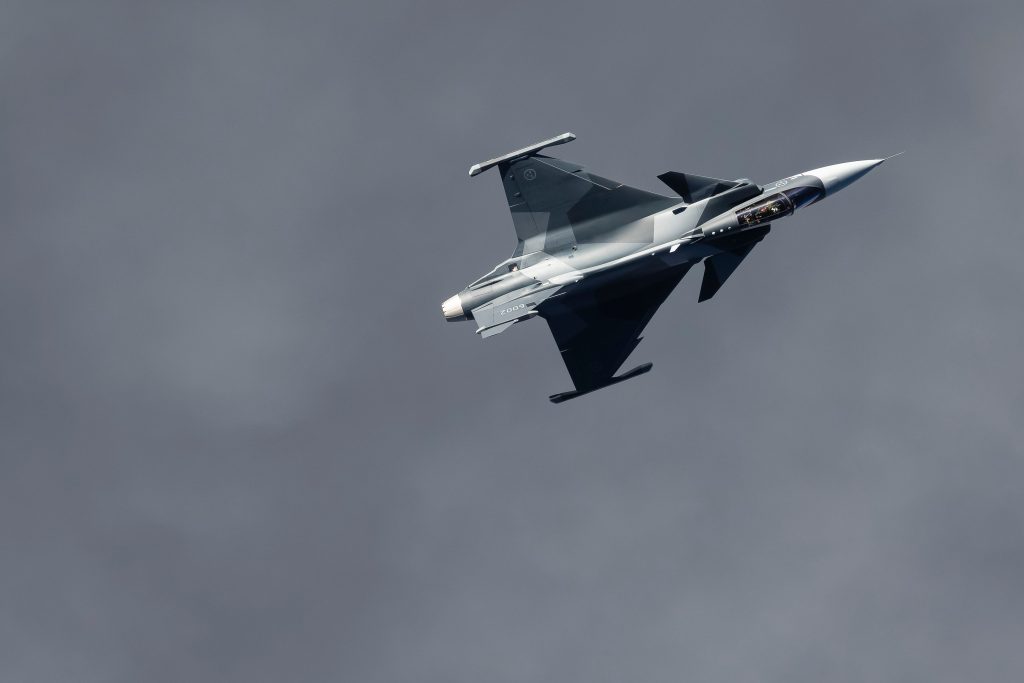
Saab is making a major impression at this year’s Defence & Security 2025 in Bangkok, presenting its largest-ever exhibit and, for the first time in Thailand, a full-scale model of the Gripen E/F multi-role fighter.
The showcase comes at a moment of particular significance. Just months ago, the Royal Thai Air Force (RTAF) confirmed its decision to select the Gripen E/F to replace its ageing fleet of F-16s, a move that marks a defining step in the country’s airpower modernisation strategy.
Largest-ever Saab Presence
Saab’s display at Defence & Security 2025 will highlight the company’s wide-ranging capabilities across the air, sea and land domains. In addition to the Gripen, the Swedish manufacturer will feature its leading systems in airborne early warning, naval combat systems, surface sensors, missile systems, counter-unmanned aerial systems (C-UAS), ground combat systems, and training and simulation solutions.
“Defence & Security is ASEAN’s leading air, sea, and land defence exhibition. The fact that it’s a tri-service event is very important. It allows Saab to showcase our broad defence portfolio and demonstrate how we integrate systems across all domains,” said Fredrik Lindblom, Head of Saab Thailand.
He added, “I’m especially pleased to bring the full-scale Gripen E fighter to Thailand for the first time, following the Royal Thai Air Force contract in August. Gripen E/F will be a driver for new technology and capabilities across the whole Royal Thai Armed Forces.”
A Deepening Relationship with Thailand
Thailand is among Saab’s most established partners in the region. The RTAF currently operates 11 Gripen C/D fighters, which were ordered in 2008 and delivered from 2011. In addition, Saab’s Erieye airborne early warning aircraft and Naval Combat Management Systems are already in service with the Thai armed forces.
Together, these platforms form one of the few fully operational network-centric warfare capabilities in Southeast Asia, a key aspect of Thailand’s long-term defence vision.
Details of Thailand’s Gripen order
Under the new modernisation plan, the RTAF will acquire 12 Gripen E/F fighters over the next decade. The first phase, covering 2025 to 2029, involves four aircraft at an estimated cost of US$596 million. The remaining eight will be delivered by 2034.
The Gripen E/F retains the type’s well-known versatility but introduces major advances in avionics, sensors, weapons integration and survivability. The fighter is equipped with the Raven ES-05 active electronically scanned array radar, an infrared search and track (IRST) system, advanced electronic warfare suites, and sensor fusion technology that enhances situational awareness in complex air combat environments.
Why Gripen Won
The RTAF spent nearly a year assessing replacement options, primarily comparing Saab’s Gripen E/F with the latest variant of Lockheed Martin’s F-16.
The final decision leaned towards the Gripen on several grounds, commonality with existing systems, life-cycle cost advantages, and interoperability with Thailand’s current command-and-control infrastructure.
“Gripen E/F is the best solution to provide Thailand with independent airpower for the future, which will contribute significantly to the nation’s safety and security,” said Micael Johansson, Saab’s President and CEO.
Fully Networked Defence
The Gripen E/F programme is expected to serve as a technological bridge across Thailand’s three services. Saab’s advanced tactical datalinks and joint command-and-control architecture are designed to allow seamless information sharing between air, land and naval assets, the foundation of a fully integrated, network-centric defence system.
“Gripen is more than just an aircraft,” Lindblom said. “It’s part of a complete ecosystem that connects every sensor and shooter across the armed forces.”
Saab’s expanded presence at Defence & Security 2025 underlines its growing partnership with Thailand and the wider ASEAN region. With the Gripen E/F now chosen as the RTAF’s next-generation fighter, the show offers Saab an opportunity not just to display technology, but to signal a long-term commitment to the Royal Thai Armed Forces.