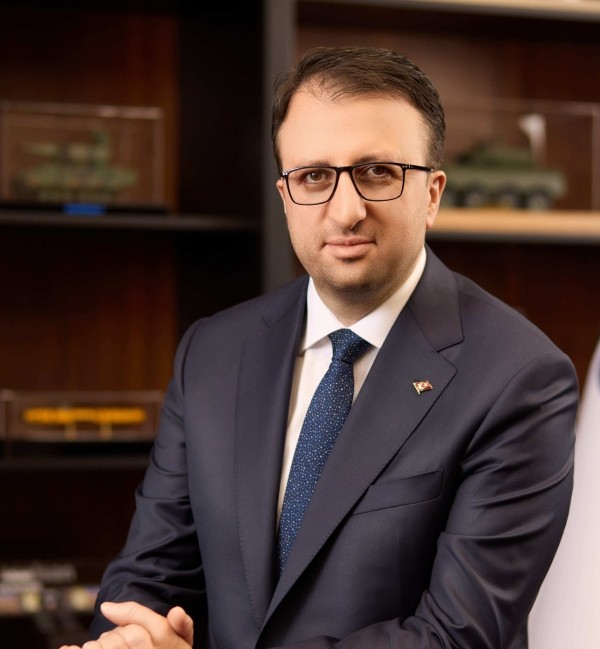
ASELSAN is set to further enhance its already deep-rooted ties with Azerbaijan’s domestic defense industry, says Ahmet Akyol, Company President & CEO.
“There is significant potential to expand localization, establish additional production capabilities and pursue joint development and production programmes by bringing together the technological strengths of ASELSAN with the engineering, manufacturing and operational capabilities of our Azerbaijani partners,” Akyol says in an interview. “We will continue to bring new technologies to Azerbaijan as its operational requirements evolve, while also looking for opportunities to deepen the technological dimension of our cooperation.”
ASELSAN Bakü is the company’s first international subsidiary, having been set up more than three decades ago. Can you briefly talk about its activities and its growth over time?
ASELSAN Bakü holds a particularly meaningful place in ASELSAN’s international journey, as it was the first subsidiary of ASELSAN outside Türkiye. From the very beginning, its presence in Azerbaijan has reflected the special relationship between our two countries, captured so well by the principle of “Two States, One Nation.”
Our activities in Azerbaijan initially focused particularly on military communications, with ASELSAN providing products and services to support the operational needs of the Azerbaijani Armed Forces. Over time, this engagement has grown considerably in both scope and depth. Over the years, ASELSAN’s engagement in Azerbaijan has expanded into areas including electro-optics, radar, electronic warfare, satellite communications and other mission-critical technologies.
Today, ASELSAN Bakü serves as much more than a platform for delivering and supporting our systems. It provides an important local interface for customer engagement, technical support and broader technological and industrial cooperation. This local presence allows us to better understand requirements on the ground and respond to them with greater agility.
Looking ahead, we see ASELSAN Bakü playing an increasingly important role in the next phase of our cooperation. Our objective is to build on the capabilities established over the past three decades and create new opportunities for technology development, industrial cooperation and local capability building. For us, this is a natural evolution of the “Two States, One Nation” relationship and a strong foundation for an increasingly integrated defense industry partnership.
Azerbaijan is the first international customer of the ASELFLIR-500 system. What are some of the company’s products currently in use by the Azerbaijan military?
The breadth of ASELSAN systems in service with the Azerbaijani Armed Forces is perhaps the clearest illustration of how our relationship has evolved from individual programmes into a broad technology partnership.
Today, we are present in Azerbaijan with products and services across almost all of ASELSAN’s major business areas. These include V/UHF radio systems, a wide range of electro-optical solutions, guided munitions, electronic warfare and radar systems, satellite communications, as well as other mission-critical technologies integrated into various Azerbaijani platforms.
ASELFLIR-500 Electro-Optical Reconnaissance, Surveillance and Targeting System is one of the latest examples of this cooperation. This system provides advanced reconnaissance, surveillance and targeting capabilities for aerial platforms, enabling high-resolution observation and precise target detection and identification.
More broadly, what matters to us is not simply the number of systems in service, but the operational value they provide when integrated into the wider defense architecture. We will continue to bring new technologies to Azerbaijan as its operational requirements evolve, while also looking for opportunities to deepen the technological dimension of our cooperation.
How has ASELSAN contributed to the development of Azerbaijan’s domestic defense industry? Do you see opportunities for further technology transfer, localization and joint production?
For ASELSAN, our cooperation with Azerbaijan has always been about more than delivering defense systems. We have sought to build capabilities that create lasting value by combining technology, engineering expertise and local knowledge.
Over the years, this has included technology cooperation, training, engineering and technical support, as well as the integration of ASELSAN technologies into Azerbaijani platforms. As our partnership has matured, we have placed increasing emphasis on developing local expertise and creating the foundations for sustainable industrial capabilities in areas such as communications, electro-optics and other advanced defense technologies.
We see the next phase of our cooperation as an opportunity to take this model further. Our ambition is to move progressively from technology transfer towards deeper co-development and co-production. This approach can create value beyond individual programmes, enabling us to develop solutions together that address future operational requirements and, where appropriate, have the potential to serve wider international markets.
Ultimately, we believe the strongest defense partnerships are those that create capabilities on both sides. Our goal is to continue building that kind of long-term industrial and technological partnership between Türkiye and Azerbaijan.
Looking at some of the ongoing conflicts and their ramifications around the globe, what do you see as some of the biggest military requirements for countries in the South Caucasus and the wider region? How well is ASELSAN positioned to meet their needs?
The most important lesson from recent conflicts is that threats no longer emerge in isolation. Drones, precision weapons, electronic warfare, air threats and cyber-enabled systems are increasingly part of the same operational environment. This is changing the way countries think about defense.
For the South Caucasus and the wider region, this means there is growing demand for capabilities that can detect threats early, maintain situational awareness, protect critical assets and preserve freedom of action in contested environments. These include advanced surveillance and reconnaissance, layered air and missile defence, counter-UAS systems, electronic warfare, secure communications, precision engagement and resilient command-and-control.
But the ability to field these capabilities individually is only part of the answer. Their real value comes from how effectively they are connected, allowing information to be collected, shared and acted upon across different domains and at the speed required by modern operations.
This is where ASELSAN’s strength becomes particularly relevant. We have expertise across radar, electro-optics, electronic warfare, communications, command and control, air defence and precision systems, together with extensive experience in integrating these technologies into networked architectures.
Our approach is therefore not simply to provide individual systems. We work with our partners to understand their operational environment and build integrated solutions around their specific requirements. In a region where threats and operational conditions are evolving rapidly, that ability to combine technologies and adapt them to the mission will be increasingly important.
As aerial threats grow, air defense systems are in high demand in the region and around the globe. Do you foresee high demand for the Steel Dome that ASELSAN is an integral part of?
The growing diversity and complexity of aerial threats are driving countries to fundamentally rethink their air defense requirements. Today, effective air defense is no longer about a single system or a single layer; it requires a networked architecture capable of detecting, tracking and engaging different types of threats with the right capability at the right range.
This is precisely the approach behind Türkiye’s Steel Dome. ASELSAN is an integral part of this architecture, contributing key technologies across detection, surveillance, electronic warfare, command and control, and air defense. By bringing these capabilities together within a single, integrated architecture, Steel Dome is designed to provide a comprehensive and layered response to a wide spectrum of aerial threats.
We believe this approach has strong relevance not only for Türkiye but also for countries facing increasingly complex aerial threats. As a result, we see significant international interest and potential for Steel Dome and the technologies that form its backbone.
At the same time, our approach is not simply to export a predefined architecture. Every country has its own geography, threat environment and operational requirements. Our strength is our ability to work together with our partners, understand their specific needs and develop an integrated air defense architecture accordingly. This partnership-driven approach will be key to meeting the growing demand for advanced air defense solutions around the world.
Is ASELSAN showcasing any new products or capabilities at ADEX?
ADEX provides an important opportunity for us to showcase ASELSAN’s latest technologies and demonstrate the breadth of our capabilities across the defense domain. This year, we are highlighting a wide range of solutions, with a particular focus on counter-drone systems, airborne technologies, electronic warfare, radar and communications.
In the counter-UAS domain, we are showcasing solutions such as KORKUT 100/25 and SARP 12.7, as well as our KALKAN II-M radar. These systems reflect our approach to addressing the rapidly evolving and increasingly diverse drone threat.
Our airborne solutions on display include advanced electro-optical systems such as ASELFLIR 600 and ASELPOD, together with a comprehensive range of precision-guidance solutions, including the TOLUN family and LGK-82 and LGK-83 guidance kits. We are also presenting our latest electronic warfare capabilities, including the ANTIDOT 2U/EA and ANTIDOT 2U/ES pods, KORAL 200, KORAL AD, PUHU and ILGAR.
In the radar domain, visitors will have the opportunity to see our MURAD 100-A and the FULMAR family, including the FULMAR 500-A, FULMAR 200-A and FULMAR 100-A. We are also showcasing our advanced communications solutions, reflecting ASELSAN’s broad expertise in secure and mission-critical communications.
Taken together, these systems demonstrate our ability to develop integrated solutions across multiple domains. More importantly, they reflect our commitment to providing our partners with technologies that address both today’s operational requirements and the emerging challenges of tomorrow.
For us, ADEX is also an opportunity to demonstrate how this broad technology portfolio can contribute to the next chapter of our cooperation with Azerbaijan. We have built a partnership over decades, and we see the continued introduction of advanced technologies, deeper industrial cooperation and the development of new capabilities together as an important part of taking that partnership forward.